
An evolving case study on training and professional development at SPD / Ian Abbott
Welcome to our first round-up of what the SPD team has been seeing, questioning and enjoying on stages across the UK.
Our new Go and See and Write programme invites every member of staff – not just those in artistic roles to spend time in theatres, encounter other artists’ work, and write honestly about what they experience. Part of the purpose of this is watching work, supporting fellow artists, and sharpening our critical thinking. Every staff member is invited to see three productions during work hours and respond with a subjective reflection – not a polished critique. Next year, we’ll gather as a team to reflect on what we’ve learned, how this work enhances our broader training, and explore what happens next.
This is the first of three blogs we’ll be sharing between now and April 2026, offering a window into what inspires us, challenges us, and shapes our viewpoints.
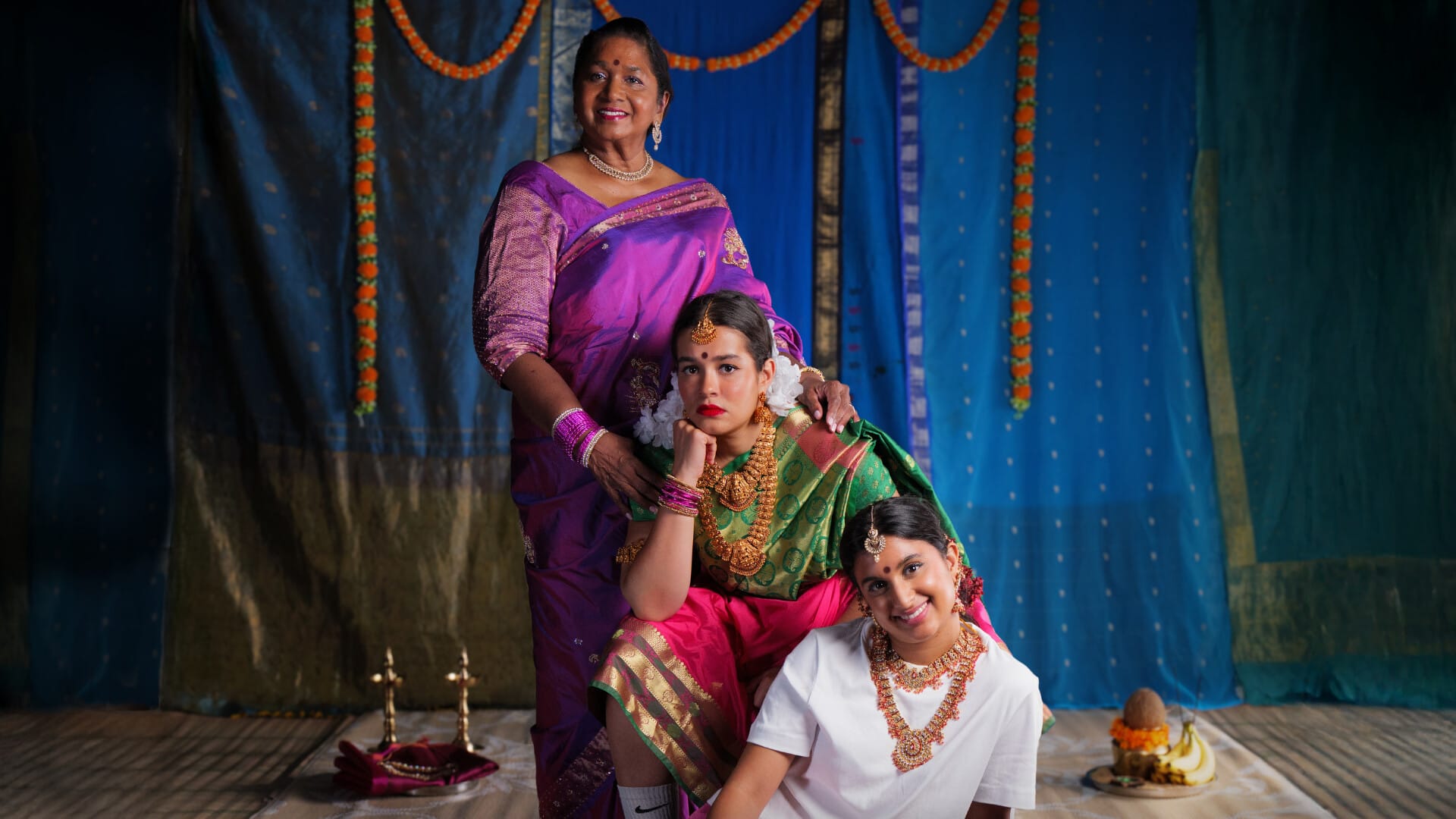
What: Period Parrrty by Gayathiri Kamalakanthan
Who: Presented by Kali Theatre and Soho Theatre
Where: Soho Theatre, London
When: 23/10/2025 – 22/11/2025
“What I found most powerful was its reflection on the relationship between language, culture and identity. It revolves around a Tamil non-binary 15-year-old called Krish, who is bracing themselves to face their upcoming “period party” – a traditional event meant to celebrate the start of womanhood. The expectation on Krish is to perform femininity in front of their friends and family, whilst being unable to communicate their real identity to their mum.
I was moved by Krish’s journey as they try to unearth traces of queerness in their own family and in Tamil cultural and religious imagery. Language (there’s no word in Tamil for non-binary) and representation shape our ability to articulate identity, and Kamalakanthan brilliantly explores how this can be especially true in the context of the Tamil diaspora, where colonialism has erased a lot of queer Tamil histories and language.
The core relationship – between Krish and best friend Brenavee – is tender and uplifting and reminds us how important it is to be around people who see us for who we really are.” Vittoria
https://www.gayathiri.co.uk
https://sohotheatre.com/events/period-parrrty/
What: Mistero Buffo by Dario Fo and Franca Rame
Who: Rhum + Clay Theatre Company in association with Pleasance
Where: Pleasance Theatre, London
When: 23/9/2025 – 11/10/2025
“I can’t help but watch this one-hander with envy in my bones. I haven’t performed in sometime as my ageing body tries to work out how it can still engage as a performer in its new era. I still feel I have more to give as a performer, so when I watch this play, and it’s chameleon performer, the brilliant Julian Spooner of Rhum & Clay, I feel a frisson of excitement.
As much as my sensibilities are broad in range, I do often have Bharatanatyam in my mind. As with this show, we, as solo trained Bharatanatyam artists, must embody numerous characters/things. Julian morphs, often at a dizzying speed, from one person to the next. The craft of doing this well and landing on each person so deftly to give us a feel of the individual and the whole is quite amazing. Not just with physicality, but with words, tone, accents, and more.
I definitely caught myself at times aware of my wide eyes, smile and gaping mouth. Of course, with a great story and well-adapted script, it was for me the performance that elevated this evening.” Seeta
What: 1 Degree Celsius by Sung Im Her
Who: Presented by Fabric
Where: Crescent Theatre, Birmingham
When: 08/11/2025
Sung Im Her is a choreographer/dancer from Korea who’s been based in London for the last 7 years. She revealed in the post-show conversation that she’d created this work between 4am-8am (UK time), working with the six other dancers and a rehearsal director based in Korea over the last 6 months.
The work is well crafted in how bodies move through space, and Her has real skill in layering choreography, creating somatic judderings and unpredictable cannons on the dancers. I’d be interested to see her work with 15+ bodies because of the geometric interplay of sharp turns, pivots, falls and patterns. It reminded me of SPD’s ROS.
It says it “looks at the topic of climate change…and has a new musical score that has been artistically inspired by data collected from rising atmospheric temperatures, and the lighting design is coordinated to the rising temperature of the earth.” This lightly political and activistish framing feels like funder/programmer catnip. If you’d written the same marketing blurb about migration, colonialism or any macro global crisis that the world is facing, then the choreography and design elements would have fit into that frame too.” Ian
https://www.sungimher.com
https://fabric.dance/events/1-degree-celsius-by-sung-im-her/
What: Midnight (public workshop presentation)
Who: By Todrick Hall
Where: Sadler’s Wells (East)
When: 11/11/2025 – 15/11/2025
“For a ‘workshop’ presentation, Midnight was already West End quality. The financier introduced the show, and within minutes, I found myself fully swept up in its world. I cried twice, laughed often, and left with my mind buzzing with ideas alongside many reflections about what it means to create a production of this scale.
Rather than feeling intimidated, I felt energised. A cast of 27 performers, supported by an eight-piece band gave the piece weight and presence. The story explored sacrifice, violence, love, loss, and suicide and at times the emotional pull was so strong that all I could do was surrender to the music.
There’s a bold twist after the interval with the entire company switching roles – the slave became the master and the master became the slave. The effect was an embodied reminder that none of us chooses the circumstances we are born into.
The show ran long and a few moments of choreography felt disconnected from the emotion, leaning more towards counts than storytelling, but the vocal performances, from the cast and the ensemble, were absolutely first-rate.” Adam
https://www.sadlerswells.com/whats-on/midnight/
What: Period Parrrty by Gayathiri Kamalakanthan
Who: Presented by Kali Theatre and Soho Theatre
Where: Soho Theatre, London
When: 23/10/2025 – 22/11/2025
“It took me a moment to get into this show. In a small scale-studio setting it can take a moment for the magic to kick in because you can literally see everything, all the seams and mechanics, close up.It made me think about different things:
- The custom of the period party is not something I’m familiar with. Contrary to popular belief, South Asian-ness isn’t monolithic. There are so many customs, food, language, fashion, religions, and more that create the rich tapestry of South Asia. I still find it fascinating that many of my family members find different south asian names/customs foreign and utterly strange. My mum finds it hard to pronounce some South Indian names. So watching this gave me an insight into something new to me. I got joy when it was clear that many in the audience understood the inside jokes in Tamil dotted throughout, even though I didn’t understand them.
- Something that got me in the feels was when mother and child, estranged by generational difference, geography of birth and lived experiences, are still trying to connect. It culminated in a singular moment of the child asking their mother ‘What did you want?’ (in reference to her younger self, before marriage and motherhood). Till then this woman had defined herself as wife/mother. But the child, going through her own turmoil, needed to know more, so they could connect with a person they couldn’t identify with. It made me think of my similarly estranged relationship with my mother. And the woman I didn’t know before she became a mother. It left me thinking about this for some days.
I’m glad to see stories that are not the usual well-worn-words and big names and this reinforces the value of small-scale theatre where it often feels like glitz, glamour and overproduction often prevail.” Seeta
https://www.gayathiri.co.uk
https://sohotheatre.com/events/period-parrrty/