
Welcome to the second round-up of what the SPD team has been seeing, questioning and enjoying on stages.
Our Go and See and Write programme invites every member of staff – not just those in artistic roles – to spend time in theatres, encounter other artists’ work, and write honestly about what they experience.
Part of the purpose of this is watching work, supporting fellow artists, and sharpening our critical thinking. Every staff member is invited to see three productions during work hours and respond with a subjective reflection – not a polished critique. Later this year, we’ll gather as a team to reflect on what we’ve learned, how this work enhances our broader training, and explore what happens next.
This is the second of three blogs (check out the first one here) which offers a window into what has been inspiring us, challenging us, and shaping our viewpoints.
What: Hedda by Tanika Gupta, inspired by Henrik Ibsen’s Hedda Gabler
Who: Presented by Orange Tree Theatre
Where: Orange Tree Theatre, London
When: 18/10/2025 – 22/11/2025
“Tanika Gupta’s Hedda does exactly what I love seeing in adaptations of classic work, as in it reimagines the original material with such boldness and vision that it breathes a whole new life into it.
This version is set in 1948 in post-war London, only one year after India’s independence from Britain. Hedda is a revered, recently retired actress of Anglo Indian descent – a heritage that she has to keep hidden from everyone, lest she risks destroying her legacy, marriage and social status.
Gupta manages to interweave a complex exploration of identity in postcolonial Britain within the structure and arcs of the original text, especially in Act 2. The new lens of the adaptation raises the stakes of the play, making it feel more relevant and gripping. The character of Hedda, ruthless as ever, here finds added depth and texture in the agonising struggle of displaced identity; Pearl Chanda’s performance as Hedda makes this tension particularly believable and compelling.” Vittoria
https://orangetreetheatre.co.uk/whats-on/hedda-on-screen/
What: TELLUS by Dickson Mbi, Co-Written by Nick Drake
Who: Dickson Mbi Company
Where: Jerwood Dance house, DanceEast, Ipswich
When: 6 Feb 2026
“Inspired by Mbi reading his son bedtime stories, TELLUS – by Olivier Award winner Dickson Mbi (and with dramaturgy by Simon McBurney) follows the journey of a man and a village tribe suffering from the consequences of a devastating drought. In their fight for survival, the kindred group begin to recognise their disconnection from Earth and their fractured relationship with the water spirit Mami Wata.
Two years in the making, this is the first show Mbi has created that he has not danced in. The piece features eight virtuosic dancers, video projection, shadow play, and atmospheric stage and lighting design, all of which connect you to this visceral and powerful work. But it is the sound design by Tony Gayle and original score by Mbi with African vocals and melodic percussion that carry the emotional pulse of the work.
The show was hypnotic, but overdone in places. The downstage projections and the cyc blocking their choreography felt unnecessary. However, these are small criticisms of what was a show full of passion and force.” Rae
https://dicksonmbi.com/tellus/
What: Devī by Poernima Gobardhan
Who: Poernima Dance Company
Where: Bijlmer Parktheater, Amsterdam
When: 13 February 2026
“Devī premiered in Den Haag in January 2026 and originally featured SPD Company Artist, Aishani Ghosh alongside Poernima Gobardhan and her sister Chandenie. However, Aishani was replaced by the kathak dancer Mahima Gulechha for this performance.
Poernima has created a contemporary movement language which is rooted in bharatanatyam; as a choreographer she crafted a cohesive and olfactory stimulating work whilst conjuring a number of stage images that nuzzled themself in my memory long after leaving the theatre. There was a sense of ethereality coming from her as a performer which challenges the notion of bharatanatyam as an earthy and rooted form, she had this weight and technical prowess but also a lightness and sense of ascent. There was a way she used the form that was different, it felt lean, but emotive, distilled but evocative.
Unfortunately the performance quality and technical execution of Chandenie and Mahima (who revealed in the post show chat that she had a cold) did not match that of Poernima. Mahima felt half a beat behind and her angles askew and Chandenie’s back and arm line was inconsistent – not always punching through and crisply delivering her arm work.” Ian
https://poernimagobardhan.nl/production/devi/
What: Tree of Life by Krishna Zivraj-Nair
Who: Sanakruti Dance
Where: Mercury Theatre, Colchester
When: 20 February 2026
“Sanskruti Dance’s Tree of Life is a small-scale work with three performers which blends Bharatanatyam and contemporary dance to explore humanity’s relationship with the natural world. Created for audiences aged 7+, it draws inspiration from the Bodhi tree of Gautama Buddha and the apple tree associated with Isaac Newton.
A recorded narrative guides the audience, helping to bridge the shifts between spirituality and science and a central illuminated tree acts as a scenic focal point and metaphor. Choreographically, I found myself wanting more dance. Whilst the mudras and nritya’s helped the young audience visualise symbols and emotions, the phrasing and spatial patterns – when the three dancers moved together – needed more finessing. It concludes with an interactive workshop, inviting the audience to learn some choreography and to explore some of the elements.
Tree of Life is a sincere piece that feels like it would benefit from a stronger directorial focus. The balance between concepts and age-appropriate clarity is uneven, leaving a sense of uncertainty about exactly which age group the work is aimed at.” Rae
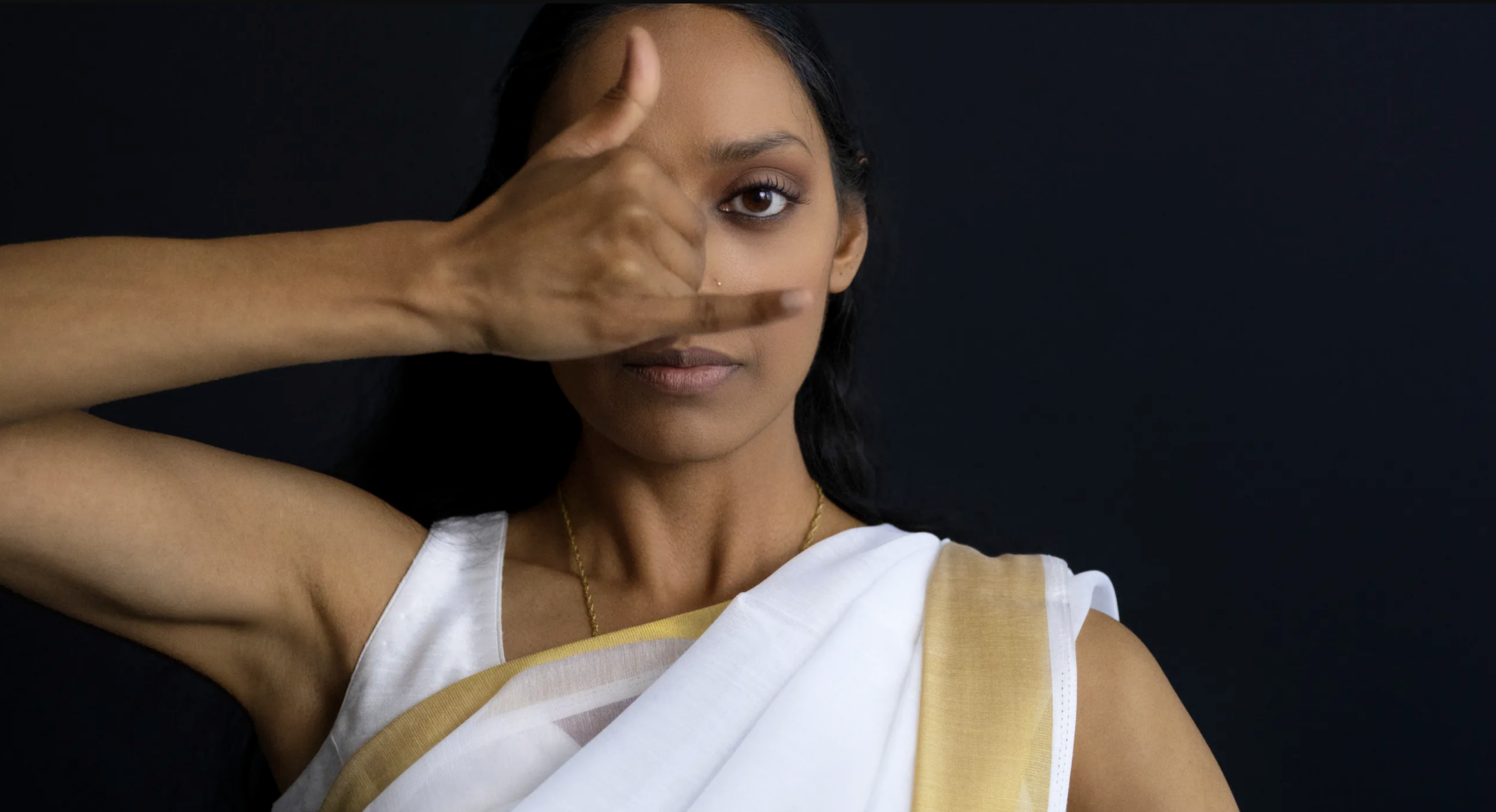
Main Image: Devī by Poernima Dance Company – Photo credit Camilla Greenwell